
USA Student Visa for Indian Students: Requirements, Fees & Process
Planning to study in the United States in 2026? The USA Student Visa for Indian Students guide covers visa types, eligibility requirements, required documents, application process, fees, and interview preparation. Renation Advisors provides personalised guidance and documentation support to help students navigate their USA study visa journey with confidence.
USA Student Visa 2026: Requirements, Types, Process, Fees & Complete Guide for Indian Students
Studying in the United States is an exciting opportunity for Indian students who want to gain an internationally recognised education, develop practical skills, and explore global career opportunities. From undergraduate degrees to specialised master's programmes, business courses, and STEM fields, the USA offers a wide range of educational options.
However, before you can begin your academic journey, understanding the USA student visa requirements, application process, financial documentation, and interview preparation is essential.
If you are planning to study in America in 2026, this guide explains everything you need to know about the USA Student Visa for Indian Students, including F-1, J-1, and M-1 visa types, required documents, application fees, processing considerations, and frequently asked questions.
At Renation Advisors, we provide personalised visa guidance and application support to help students understand the process and prepare their applications with greater confidence.
What Is a USA Student Visa?
A USA student visa is a non-immigrant visa that allows eligible international students to travel to the United States for a specific course of study or an approved exchange programme.
The appropriate visa depends on the institution, course type, and programme structure. Students must first secure admission to a qualifying US institution or an approved exchange programme before applying for the relevant visa.
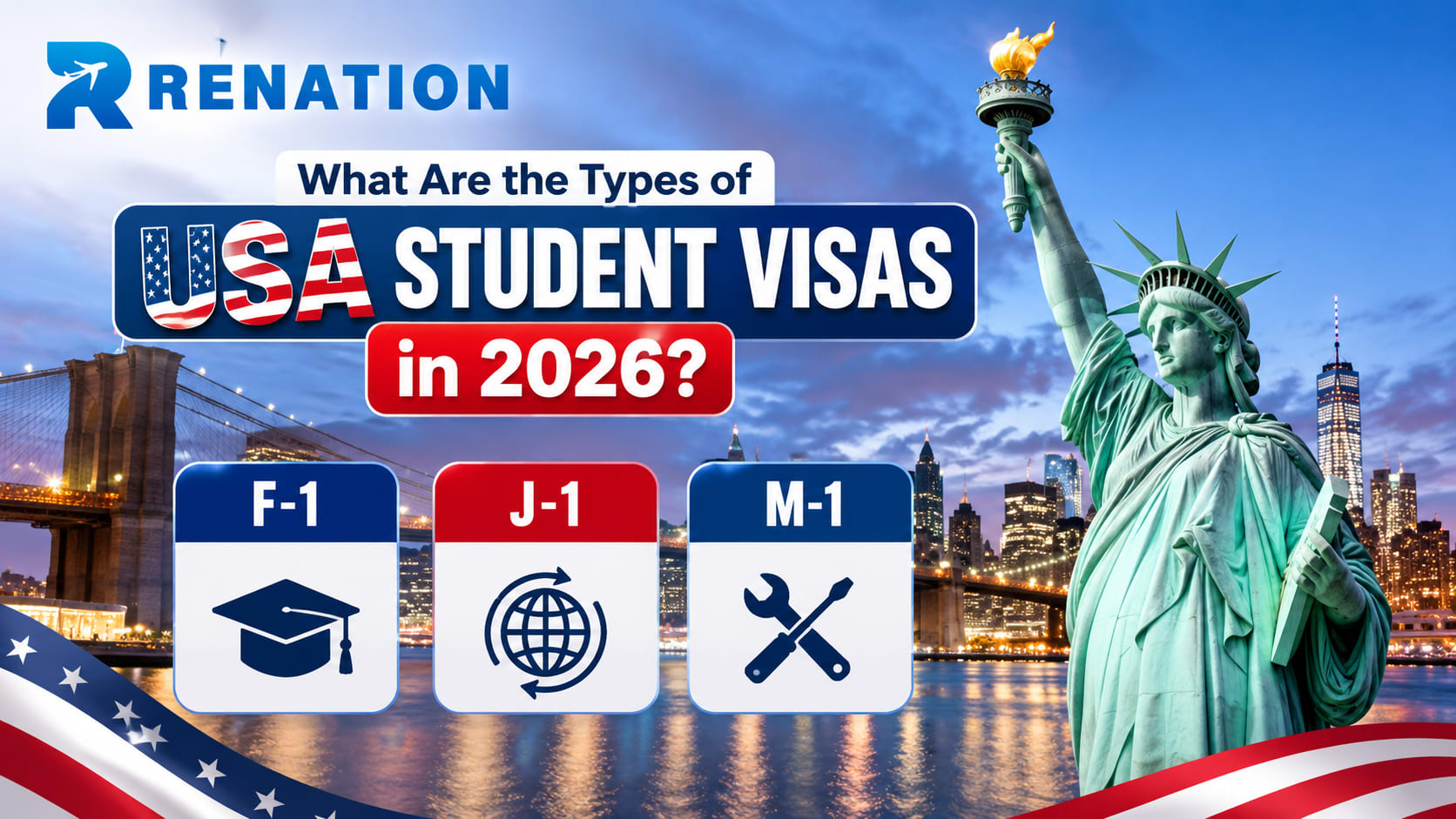
The US government offers three primary student visa categories:
- F-1 Student Visa: For academic studies at an eligible college, university, school, or English language institute.
- J-1 Exchange Visitor Visa: For participation in approved educational and cultural exchange programmes.
- M-1 Student Visa: For eligible vocational or non-academic studies.
Choosing the correct visa category is an important first step towards studying in the United States.
What Are the Types of USA Student Visas in 2026?
Understanding the differences between student visa categories can help you identify the option that matches your educational plans.
1. F-1 Student Visa USA
The F-1 visa is the most common option for international students pursuing academic education in the United States.
It may be suitable for students enrolling in:
- Bachelor's degree programmes
- Master's degree programmes
- Doctoral and research programmes
- Eligible college and university courses
- English language training programmes
To apply, you generally need admission to a Student and Exchange Visitor Program (SEVP)-certified institution. The institution will issue Form I-20 after completing the required student registration process.
F-1 students must maintain their student status and follow the applicable rules regarding attendance, course enrollment, and employment.
2. J-1 Exchange Visitor Visa USA
The J-1 visa is designed for participants in authorised exchange visitor programmes.
Depending on the programme, it may cover:
- University and secondary-school exchanges
- Research and academic exchanges
- Certain training and educational programmes
- Approved cultural exchange opportunities
Applicants generally receive Form DS-2019 from their designated programme sponsor. Some J-1 participants may also be subject to a two-year home-country physical presence requirement, depending on their circumstances.
3. M-1 Student Visa USA
The M-1 visa is intended for eligible students pursuing vocational or non-academic education.
Examples may include qualifying technical, practical, and career-focused training programmes.
Applicants must meet the requirements of the institution and the M-1 visa category. Employment and practical training options under this category are more restricted than those available to certain F-1 students.
Which USA student visa is best for Indian students?
For most Indian students planning to pursue a conventional bachelor's or master's degree, the F-1 visa is generally the relevant category. The J-1 and M-1 visas apply to specific exchange and vocational programmes.
What Are the USA Student Visa Requirements for Indian Students in 2026?
Indian students must satisfy the relevant immigration requirements and demonstrate that their proposed study plans are genuine and financially realistic.
The main USA student visa requirements include the following.
1. Admission to an Eligible US Institution
You must first receive admission to an institution that can support the student visa category you intend to apply for.
For F-1 and M-1 students, this generally means an SEVP-certified school. For J-1 applicants, the programme must be authorised under the applicable exchange visitor framework.
2. Valid Passport
You need a valid passport for international travel. Check its expiry date well in advance and follow the passport-validity requirements applicable to your situation.
3. Proof of Financial Support
You must demonstrate how you will pay for your education and living expenses in the United States.
Depending on your circumstances, evidence may include:
- Personal or family bank statements
- Education loan sanction letters
- Scholarship or financial aid letters
- Sponsor income documents
- Tax returns and other financial records
- Evidence of funds available for tuition and living costs
The amount required depends on your university, course fees, location, and the financial information recorded for your programme.
4. Academic Qualifications
You should have the academic qualifications required by your chosen institution.
These may include Class 10 and Class 12 certificates, undergraduate transcripts, degree certificates, entrance examination scores, or other supporting documents.
5. English Language Proficiency
Universities may require English proficiency test results such as IELTS, TOEFL, or other accepted assessments. Some institutions offer alternative ways to demonstrate proficiency.
English test requirements are determined by the institution and course. Visa eligibility and university admission requirements should not be confused with one another.
6. Genuine Study Plans
During the visa interview, you should be able to explain why you selected your course, university, and the United States as your study destination.
You should also understand your course structure, estimated expenses, funding arrangements, and future plans.
7. Compliance With Immigration Rules
You must qualify under the relevant non-immigrant visa provisions and comply with the conditions attached to your visa status.
Meeting the basic requirements does not guarantee visa approval. The consular officer assesses each application individually.
Documents Required for a USA Student Visa
Preparing your documents carefully can make the application process easier and help you respond to questions about your academic background and finances.
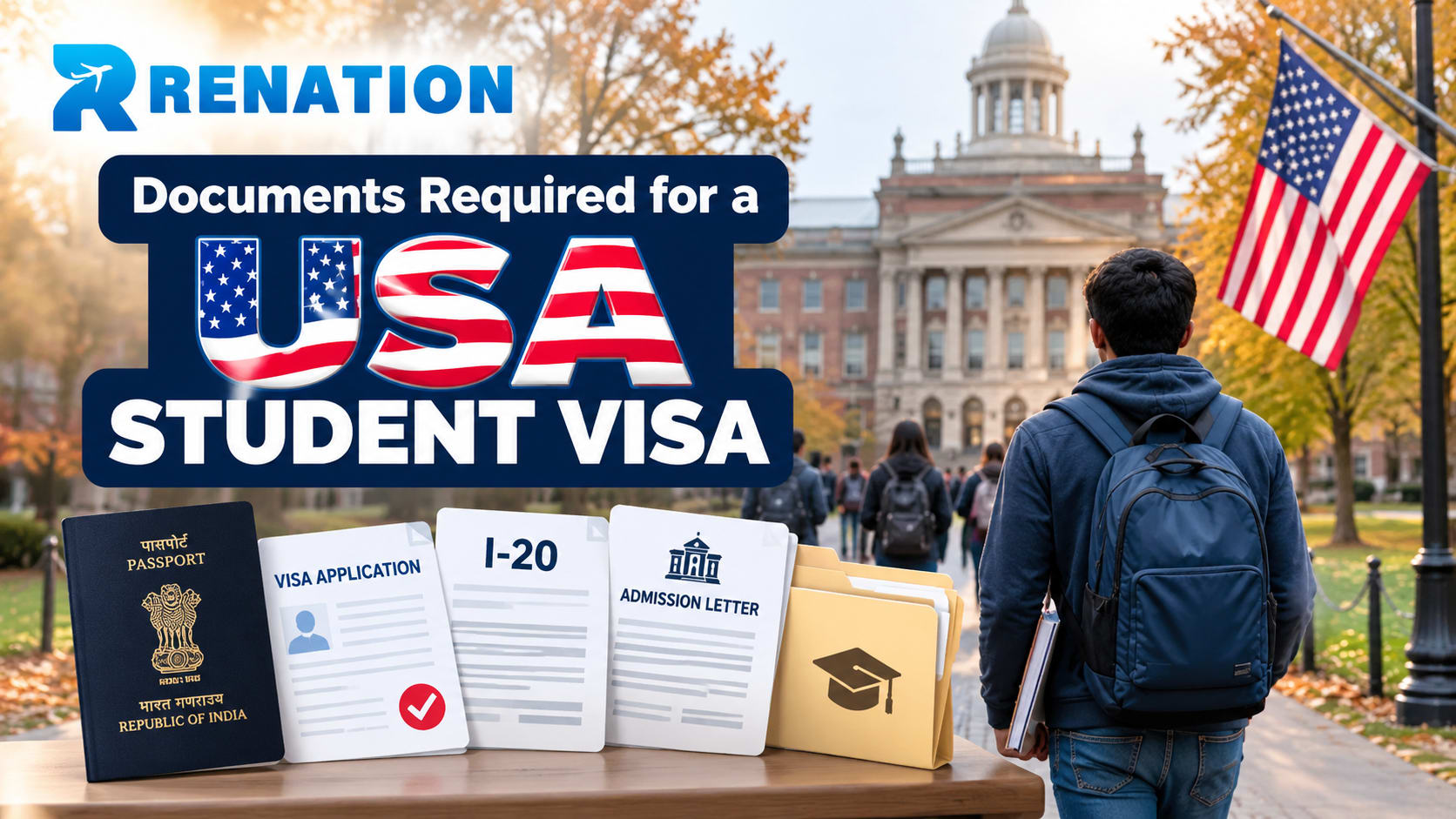
The following checklist covers commonly required documents for F-1 and M-1 student visa applicants.
Essential USA Student Visa Documents
- Valid passport
- Completed Form DS-160 confirmation page
- Visa application fee payment receipt, where applicable
- Visa-compliant photograph, if required
- Form I-20 issued by your eligible institution
- Proof of SEVIS I-901 fee payment, if applicable
- University admission letter
- Academic transcripts, certificates, and degrees
- Standardised test scores, if applicable
- Financial documents showing how you will fund your studies
- Scholarship or education loan documents, if applicable
- Information about your intended course and study plans
For J-1 applicants, Form DS-2019 and programme-specific documents are generally relevant instead of the F-1/M-1 Form I-20.
The consular officer may request additional evidence depending on your individual case. Always review the latest instructions from the US Embassy or Consulate where you will apply.
How to Apply for a USA Student Visa From India: Step-by-Step Process
Applying for a USA student visa involves several stages. Starting early allows you to prepare your academic, financial, and immigration documents without unnecessary last-minute pressure.
Step 1: Choose Your Course and University
Research universities and colleges based on your academic background, preferred specialisation, tuition budget, location, and long-term educational goals.
Check the institution's accreditation, available programmes, admission requirements, scholarships, and international student support.
For an F-1 or M-1 visa, verify that the institution is SEVP-certified.
Step 2: Apply for University Admission
Submit your application along with the required academic records, test scores, essays, recommendation letters, and other documents requested by the institution.
Once accepted, review the offer carefully and complete the university's enrolment and financial documentation requirements.
Step 3: Receive Form I-20 or DS-2019
After the necessary processing, an eligible F-1 or M-1 institution issues Form I-20. J-1 exchange participants generally receive Form DS-2019 from their programme sponsor.
Check that your name, programme details, dates, and other information are accurate.
Step 4: Pay the Applicable SEVIS Fee
Eligible students must pay the SEVIS I-901 fee before the visa interview, subject to the applicable rules and exemptions.
Keep your payment confirmation for your records. This is separate from the standard student visa application fee.
Step 5: Complete the DS-160 Application Form
Complete the online Nonimmigrant Visa Application, Form DS-160, with accurate and consistent information.
Review your personal details, education history, travel information, and other answers before submitting the form. Print or save the confirmation page as instructed.
Step 6: Pay the Visa Application Fee
Pay the applicable visa application fee according to the official instructions for applicants applying in India.
Keep your payment confirmation and follow the current appointment booking procedure.
Step 7: Schedule Your Visa Appointment
Book your appointment according to the current procedures and available slots.
Appointment availability and waiting times can vary by location and season. Check the official US visa appointment information rather than relying on outdated processing estimates.
Step 8: Prepare for Your Visa Interview
Review your course, university, financial arrangements, and reasons for studying in the United States.
Practise explaining your plans naturally and truthfully. Do not memorise artificial answers or provide misleading information.
Carry the required documents in an organised folder.
Step 9: Attend the Interview and Follow the Outcome
Attend your appointment with the required documents. The consular officer will assess whether you qualify for the requested visa.
If your visa is approved, follow the passport-return and travel instructions. If additional administrative processing is required, follow the instructions provided by the consular authorities.
Do not make non-refundable travel arrangements until your visa has been issued.
What Is the USA Student Visa Fee in 2026?
Understanding the cost of a USA student visa helps Indian students plan their education budget more accurately.
The following are the main government-related charges to consider.
Fee type | Amount or explanation |
F-1/M-1/J-1 visa application fee | US$185 standard application fee, subject to applicable exemptions and current rules |
SEVIS I-901 fee | Separate fee; amount depends on visa category and applicable rules |
University application fee | Varies by institution |
Tuition fees | Depends on the course and university |
Living expenses | Depends on the city and lifestyle |
Travel and insurance | Varies by individual requirements |
The US$185 visa application fee is generally non-refundable. The SEVIS fee is a separate charge and may differ by category or programme.
For the latest official information, consult the US Department of State's student visa guidance and visa fee schedule.
How Much Money Is Required to Study in the USA?
There is no single financial amount that applies to every Indian student.
Your estimated budget may include:
- Tuition and university fees
- Accommodation and food
- Health insurance and personal expenses
- Books, supplies, and transportation
- Visa and SEVIS charges
- International travel expenses
Your institution's cost estimates and Form I-20 are useful starting points for understanding the funds you need to demonstrate.
You should prepare credible financial evidence showing how your education and living expenses will be covered. Do not rely on the assumption that future part-time employment will pay for your entire course.
How Long Does It Take to Get a USA Student Visa?
USA student visa processing time varies depending on the appointment location, season, individual circumstances, and whether additional administrative processing is necessary.
The overall timeline includes more than the interview itself. It may involve university admission, document preparation, issuance of the I-20 or DS-2019, fee payment, appointment scheduling, and passport return.
New F-1 and M-1 students may generally be issued visas up to 365 days before the programme's start date, but they cannot enter the United States more than 30 days before that start date.
Tip for 2026 applicants: Begin your university and visa preparation early, especially if you are targeting a specific intake. Check official appointment availability regularly because no fixed processing time can be guaranteed.
Does an F-1 USA Student Visa Allow You to Work?
Yes, F-1 students may work in certain circumstances, but employment is subject to specific immigration rules. A student visa does not provide unrestricted permission to work anywhere in the United States.
On-Campus Employment
Eligible F-1 students may generally work on campus subject to applicable conditions. During the academic term, on-campus employment is usually limited to 20 hours per week while school is in session.
Different rules can apply during official school breaks and in other circumstances.
Off-Campus Employment
Off-campus work is more restricted and generally requires eligibility under an authorised category.
Options may include:
- Curricular Practical Training (CPT)
- Optional Practical Training (OPT)
- Certain employment authorisations based on qualifying hardship or other specific provisions
Students must meet the relevant requirements and obtain any necessary authorisation before starting employment.
Can You Work After Completing Your Degree?
Eligible F-1 students may apply for Optional Practical Training, commonly called OPT, subject to the applicable requirements.
Certain eligible STEM graduates may qualify for a 24-month STEM OPT extension after the initial OPT period, provided they meet the relevant conditions.
Approval is not automatic. Students should consult their university's designated school official and the official US immigration guidance before making employment plans.
Is the USA Giving Student Visas to Indian Students in 2026?
Student visa applications are subject to current US immigration rules, consular procedures, appointment availability, and individual eligibility assessments.
The US government provides official application procedures for F-1, M-1, and J-1 applicants. However, this does not guarantee that every applicant will receive an appointment or visa approval.
Indian students should check current appointment availability, documentation requirements, and any applicable screening procedures through official US government sources.
Avoid relying on social media rumours or promises of guaranteed approval. Your application should reflect your genuine academic plans, accurate financial information, and compliance with the relevant requirements.
Common USA Student Visa Interview Questions for Indian Students
The visa interview is an important part of the application process. Questions may focus on your academic background, selected course, university, financial resources, and study plans.
Here are examples of questions you may be asked.
1. Why Do You Want to Study in the USA?
Explain how your chosen course supports your academic interests and career goals. Mention relevant features of the programme rather than relying on general statements about America.
2. Why Did You Choose This University?
Be prepared to discuss the course curriculum, specialisations, academic facilities, research opportunities, or other genuine reasons for selecting the institution.
3. Who Will Sponsor Your Education?
Clearly explain how your education will be funded. If your parents or another sponsor will pay, understand their financial circumstances and the supporting documents available.
4. What Will You Do After Completing Your Course?
Describe your genuine future plans and explain how the course fits your broader goals. Your response should be truthful and consistent with the information in your application.
5. Why Are You Not Studying This Course in India?
Explain the specific academic or professional benefits of the US programme and why it matches your objectives.
6. What Is the Total Cost of Your Education?
Know your tuition fees, estimated living expenses, available funding, and the financial arrangements supporting your studies.
7. What Will You Do If Your Visa Is Refused?
Answer honestly. You should understand that visa issuance is discretionary and that you must follow the official process if your application is refused.
The best preparation is to understand your own application thoroughly and answer questions clearly, confidently, and truthfully.
What Are the Common Reasons for USA Student Visa Refusal?
A visa refusal can occur for different reasons depending on the applicant's circumstances and the applicable immigration law.
Potential concerns may include:
- Insufficient evidence of financial support
- Inconsistent information across application documents
- Inability to explain the chosen course or institution
- Questions about the applicant's eligibility under the relevant visa provisions
- Incomplete or inaccurate application information
- Failure to satisfy the applicable legal requirements
For example, a student who cannot explain how tuition and living expenses will be paid may face concerns about the financial credibility of the application.
There is no guaranteed formula for approval. The best approach is to prepare a complete, accurate application and address any genuine weaknesses before submitting it.
How Can Renation Advisors Help With a USA Student Visa Application?
Choosing the right course and preparing a student visa application can involve multiple steps, particularly for students applying from India for the first time.
Renation Advisors is one of the best immigration and multiple visa provider companies, offering guidance to individuals planning their international education and travel journeys.
Our support can help students understand the application requirements, organise their documentation, and prepare for the next steps in their visa journey.
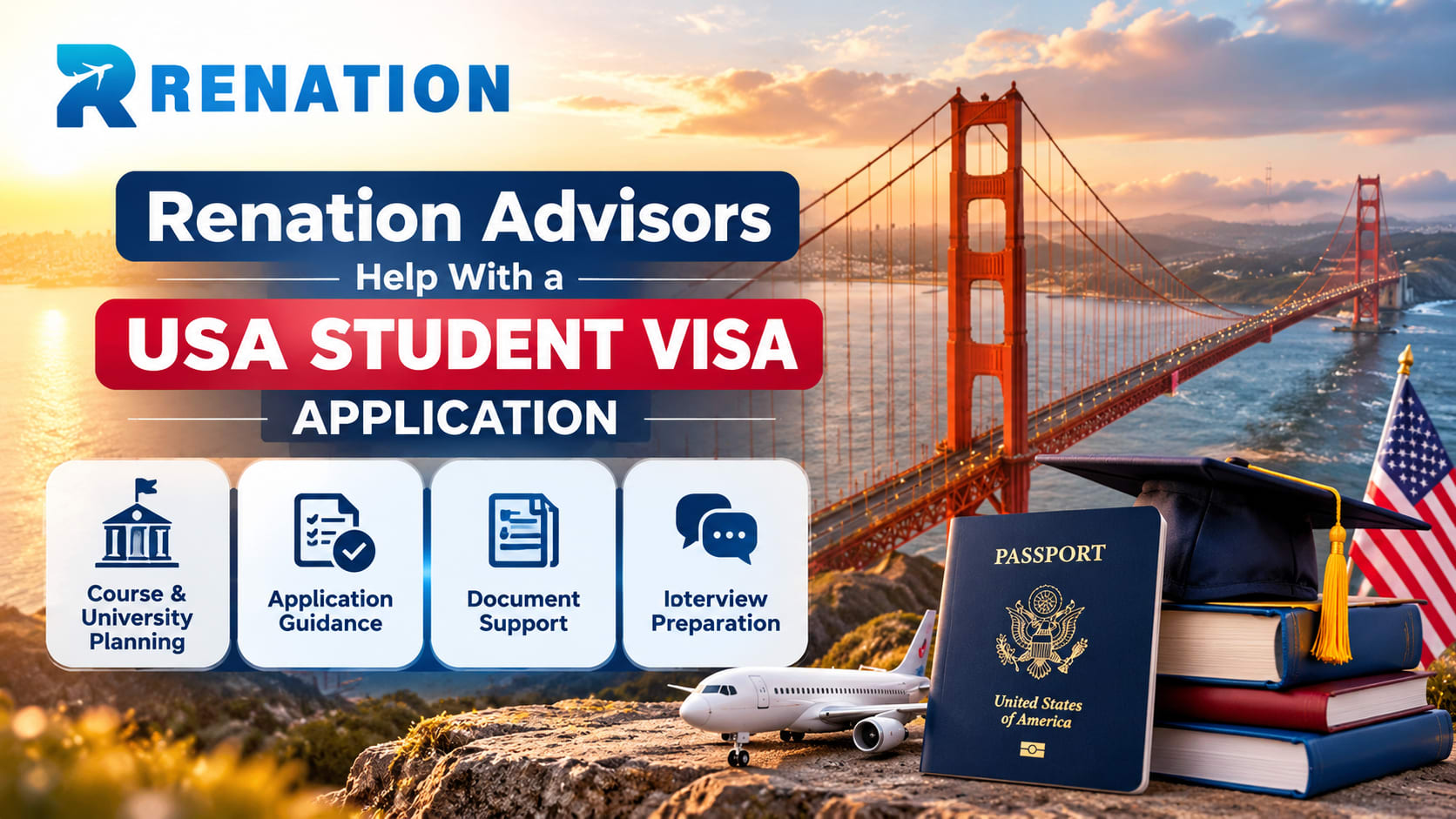
Our USA Student Visa Guidance May Include:
- Course and university planning support
- Guidance on student visa requirements
- Document checklist and application preparation
- Financial documentation guidance
- DS-160 and application process guidance
- Student visa interview preparation
- Updates on relevant application procedures
- Assistance in understanding documentation concerns and next steps
Every student's academic background, financial circumstances, and application history are different. Our approach focuses on understanding your situation and providing guidance relevant to your requirements.
We also provide support for other visa categories, including study, tourist, visitor, work, and permanent residence pathways, depending on the destination and applicable eligibility requirements.
Our aim is to make the process clearer, more organised, and easier to understand.
Frequently Asked Questions About the USA Student Visa 2026
1. What is the most common student visa for the USA?
The F-1 visa is the most common category for international students pursuing academic programmes at eligible US schools, colleges, and universities.
2. What are the requirements for a student visa in the USA?
Applicants generally need admission to an eligible institution or programme, the appropriate eligibility document, a valid passport, a completed visa application, financial evidence, and the ability to satisfy the applicable visa requirements.
3. How much is the USA student visa fee for Indian students in 2026?
The standard application fee for F-1 and M-1 visas is US$185, subject to applicable exemptions and current rules. The SEVIS I-901 fee is separate, and additional education and travel expenses must also be budgeted for.
4. Is the USA giving student visas now?
Applications are governed by current US immigration rules and consular procedures. Students should check official appointment availability and requirements before applying. Approval is not guaranteed.
5. Does an F-1 visa allow students to work?
Eligible F-1 students may work in certain authorised circumstances, including qualifying on-campus employment and approved practical training. Restrictions apply, and students must follow the relevant rules.
6. Can I get a USA student visa without IELTS?
Possibly. IELTS is not a universal visa requirement for every applicant. However, your chosen university may require IELTS, TOEFL, or another form of English proficiency evidence. Admission and visa requirements are separate.
7. How much bank balance is required for a USA student visa?
There is no universal bank balance applicable to every student. You should demonstrate credible access to sufficient funds for the tuition and living expenses associated with your programme, based on your institution's cost estimates and individual circumstances.
8. Can I apply for a USA student visa after a study gap?
A study gap does not automatically mean that you cannot apply. You should be able to explain your academic or professional activities during the gap and show how your proposed course fits your current plans. The final decision depends on your overall eligibility.
9. When should I apply for a USA student visa?
Begin researching universities and preparing your application well before your intended intake. Visa appointment availability and processing times vary, so check the official guidance and coordinate your application with your course start date.
10. Can my spouse or children accompany me on a USA student visa?
Eligible spouses and unmarried children under 21 may qualify for dependent status, generally F-2 or M-2 for eligible F-1 or M-1 students. Each dependent must meet the applicable requirements and obtain the required documentation.
11. Is a USA student visa guaranteed after university admission?
No. University admission and visa approval are separate decisions. Applicants must independently satisfy the applicable immigration requirements, and the consular officer makes the visa decision.
12. Can I get permanent residency after studying in the USA?
Studying in the United States does not automatically lead to permanent residency. Any future immigration pathway depends on the individual's circumstances, eligibility, and the immigration options available at that time.
Conclusion
Start Your USA Study Journey in 2026 With the Right Guidance
The United States offers a wide range of academic opportunities for Indian students, but successful planning requires more than choosing a university. Understanding the correct visa category, preparing financial documents, completing the application accurately, and getting ready for the interview are all important parts of the process.
Whether you are planning a bachelor's degree, master's programme, vocational course, or approved exchange programme, begin early and verify the latest official requirements before applying.
Renation Advisors is here to guide you through your international visa journey. As an immigration and multiple visa provider company, we aim to provide personalised guidance, documentation support, and assistance throughout the application process, based on your individual needs.
Contact Renation Advisors today to discuss your USA Student Visa 2026 plans.
Leave a Comment
Your email address will not be published. Required fields are marked *