
Singapore 6+6 Program: Study & Work Experience | Renation Advisors
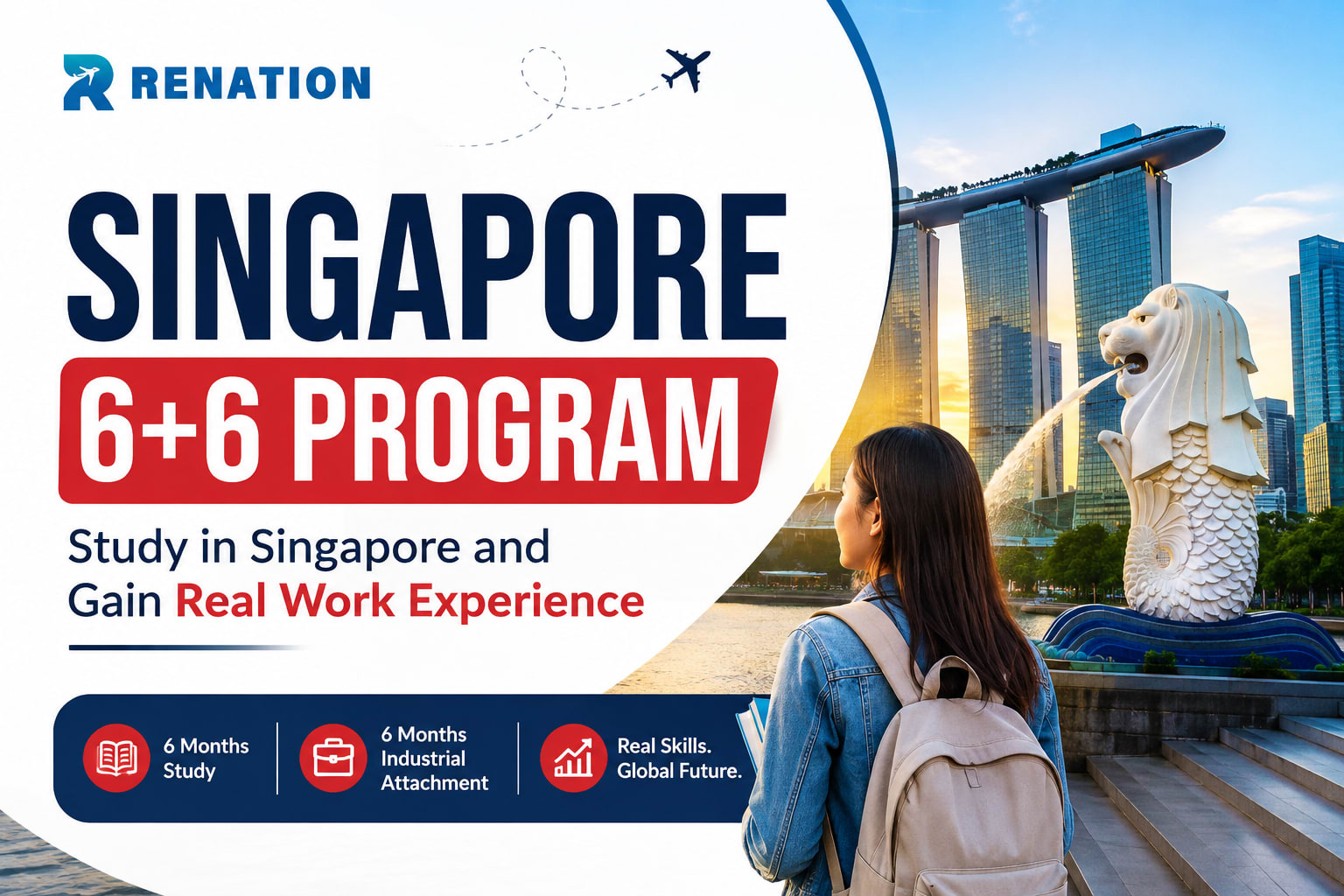
Thinking about studying in Singapore and gaining international work experience? The Singapore 6+6 pathway combines approximately 6 months of academic training with around 6 months of industrial attachment, depending on the course and institution. It can be an attractive option for students looking for career-focused education, practical exposure and global experience.
From hospitality and logistics to supply chain management, students can explore career-oriented diploma programmes based on their academic background and career goals
Singapore 6+6 Program: Study in Singapore and Gain Real Work Experience
Ever wished you could study abroad and actually walk away with real work experience, not just a certificate? That's basically the idea behind the Singapore 6+6 Program, and it's why more and more international students are starting to ask about it.
In simple terms, the program mixes around 6 months of classroom-based study with roughly 6 months of hands-on industrial attachment or internship. The exact split depends on the course and the institution you choose, but the core idea stays the same: learn the theory, then go put it to work.
What makes Singapore a smart pick for this kind of program is its business environment. It's compact, well connected, and full of international companies, which means students get exposure that's hard to match elsewhere.
Here's the part that surprises a lot of students: some of these career-focused courses don't require a university degree or a sky-high academic score to get in. So if you've been holding back because you think you need a degree or perfect grades to study abroad, this might change how you look at things.
A quick note before we dive in: course length, admission rules, English requirements, internship setups, Student's Pass eligibility, and costs all vary from one institution to another. Always double-check the specifics with the college you're considering before you commit.
What Exactly Is the Singapore 6+6 Program?
Think of it as two halves of the same journey.
Half one, roughly 6 months: You're in the classroom, building up your knowledge of the field, learning the theory, and picking up the technical skills that matter for your industry.
Half two, roughly 6 months: You step out of the classroom and into an actual workplace through an industrial attachment, applying what you just learned in a real business setting.
The appeal is obvious. Instead of finishing your course and then scrambling to find internship opportunities on your own, a well-structured program builds that experience right into the curriculum. You graduate with something more than a piece of paper.
That said, not every course in Singapore follows this exact format, so it's worth confirming with your chosen school whether their program actually runs on a 6+6 structure.
Why Are So Many Students Looking at Singapore Right Now?
Singapore has built itself into one of Asia's biggest business hubs. Logistics companies, hotel chains, banks, tech firms, manufacturers, you name it, they're all here. For a student, that means you're not just studying in a classroom somewhere quiet; you're studying in a city that's actually running these industries at scale.
If your interests lie in any of these areas, Singapore is worth a serious look:
- Hospitality and tourism
- Logistics and supply chain
- International business
- Business management
- Retail and services
- Operations
- Global trade
If your goal is to build practical, job-ready skills rather than just collect another degree, a career-focused course here can genuinely help.
How Does the 6+6 Pathway Actually Work?
Stage One: Learning the Fundamentals (About 6 Months)
This is the classroom stage. You'll be attending lectures, working through assignments, and getting a grip on the subject matter, whatever that happens to be for your course. Common subjects include:
- Business operations
- Hospitality management
- Supply chain management
- Logistics
- International business
- Customer service
- Management
- Global business practices
It's designed to give you a solid base before you're thrown into the real world.
Stage Two: Getting Your Hands Dirty (About 6 Months)
This is where things get interesting. Your industrial attachment lets you see how businesses actually operate day to day, and it gives you the chance to apply what you learned instead of just reading about it in a textbook.
For international students especially, this stage tends to build things that are hard to teach in a classroom:
- Workplace communication
- Professional discipline
- Real industry knowledge
- Teamwork
- Customer-service skills
- Hands-on operational experience
- Exposure to an international workplace
According to Singapore's Ministry of Manpower (MOM), Student's Pass holders can take part in an industrial attachment without needing a separate work pass, as long as it's conducted under the right rules and counts toward the institution's graduation requirements. So before you get too excited, check that your specific course and school actually qualify under these regulations.
Which Courses Are Worth Considering?
The right course really comes down to your background, your goals, and what you're eligible for. Here are a few popular options.
Diploma in International Hospitality Management
Hospitality is one of those industries that exists everywhere: hotels, restaurants, tourism, events, you name it. A hospitality diploma usually covers:
- Hotel operations
- Guest relations
- Food and beverage operations
- Tourism
- Customer service
- Hospitality management
If you like working with people and want a career you can take almost anywhere in the world, this is worth a look.
Diploma in Logistics and Supply Chain Management
Singapore's position as a global trade hub makes this a genuinely smart choice. Expect coursework around:
- Supply chain operations
- Warehousing
- Transportation
- Inventory management
- Procurement
- Distribution
- Global logistics
Nearly every large company depends on a functioning supply chain, so this field tends to open doors across many different industries.
Diploma in Global Supply Chain Management
For students more interested in how products, services, and information move across international markets, this option digs deeper into the global side of trade and business operations. As always, the exact curriculum and internship setup will differ by institution.
Who Can Actually Apply?
Here's the good news: some of these career-focused diplomas don't require a bachelor's degree. Depending on the school and program, you might be eligible with just a Grade 10 or Grade 12 qualification.
That opens the door to a wider group of students, including:
- Students who've completed Grade 10
- Students who've completed Grade 12
- Students without a bachelor's degree
- Students interested in vocational training
- Students who want real international exposure
- Students who simply want a head start on their career
Just keep in mind there's no single age or academic rule that applies across the board. Every institution sets its own criteria, so check before you assume anything.
Do You Need IELTS?
This comes up in almost every conversation, and the honest answer is: it depends on where you're applying.
Some institutions accept alternative proof of English proficiency, while others will ask for IELTS scores directly. Don't assume it's automatically waived just because a program is marketed under the 6+6 label. If you don't have IELTS, your best move is to look for institutions whose admission requirements actually line up with your current profile.
What About the Student's Pass?
If you're studying full-time in Singapore, you'll typically need a Student's Pass, and the institution you choose has to be eligible to sponsor one. Singapore's Immigration and Checkpoints Authority (ICA) states that foreign students enrolling in full-time, non-religious courses at an EduTrust-certified private education institution can apply for this pass.
Don't pick a course just because it looks cheap or fast. Before you commit, check:
- Whether the institution is officially eligible
- Whether the course qualifies for a Student's Pass
- Whether it's genuinely full-time
- Whether the industrial attachment is actually built into the program
- Whether your own profile meets the admission bar
Can You Work During Your Internship?
Here's something students often get wrong: a Student's Pass does not give you unlimited permission to work.
MOM is clear that Student's Pass holders can only work under specific conditions, and an industrial attachment is allowed only when it's genuinely part of your course requirements and follows the applicable rules. For certain training arrangements, a separate route called the Training Work Permit may apply instead.
Bottom line: confirm exactly what your internship and work authorization will look like before you pay a single rupee toward any program.
Will You Get Paid During the Internship?
Some internships come with a stipend. Some don't. It really depends on the employer, the industry, the role, and the specific arrangement your institution has in place.
You'll sometimes see a figure like SGD 700-800 a month floating around online. Treat that as a rough example, not a promise. Never choose a program purely because of an advertised stipend; focus on the education and experience you're actually getting.
What Does "Payment After Visa" Actually Mean?
This phrase gets thrown around a lot by consultants and agents, and it's worth understanding clearly before you sign anything. If someone offers you a "payment after visa" deal, get everything in writing, specifically:
- Admission fees
- Tuition fees
- Visa or application charges
- Refund policy
- Payment conditions
- What happens if your Student's Pass gets rejected
- Internship arrangements
- Accommodation and living costs
- Any additional admin charges
A clear, written agreement upfront saves you a massive headache later.
Is This a Good Fit If Your Budget Is Tight?
If you're working with a limited budget and thinking something like, "I don't have a bachelor's degree, my budget is under 4 lakh rupees, and I still want to study and work abroad," Singapore's career-focused programs are genuinely worth exploring.
But don't treat that 4 lakh figure as a fixed total cost. Tuition, visa fees, accommodation, food, insurance, and travel all add up differently depending on your course and lifestyle. Always ask for the complete cost breakdown for your specific situation before you decide.
What Do You Actually Gain From This Pathway?
International exposure. You get to study inside one of Asia's most connected business environments.
Real work experience. The built-in industrial attachment means you leave with practical, hands-on experience, not just theory.
Job-ready skills. Hospitality, logistics, and supply chain courses teach skills that transfer across industries.
No degree required for some programs. Certain diploma courses accept students straight out of secondary school.
A genuinely global environment. Singapore's mix of cultures and industries gives you exposure you simply won't get sitting in a classroom back home.
What to Check Before You Apply
Do your homework before you commit to anything:
- Is the institution officially recognized?
- Is it EduTrust-certified, where applicable?
- Is the course properly accredited?
- Are you eligible for a Student's Pass?
- Do you meet the academic requirements?
- What are the English-language requirements?
- How long does the course actually run?
- What does the industrial attachment involve?
- Are you eligible for the internship?
- What's the work authorization situation?
- Is a stipend guaranteed, and how much?
- What's the refund policy?
- What's the total cost, realistically?
ICA advises students to make sure they've been accepted into an approved full-time course before applying for a Student's Pass, so get your admission sorted first.
Frequently Asked Questions
Is the Singapore 6+6 Program an official government visa scheme?
Not exactly. "6+6" describes how a course is structured, not a separate visa category. The actual immigration document you'll need is a Student's Pass, issued under ICA's requirements.
Can a student who's only completed Grade 10 apply?
Some diploma or vocational programs accept Grade 10 qualifications, but it varies by institution. Always check the specific admission criteria before applying.
Can I study without IELTS?
Some schools accept alternative English proficiency proof, but IELTS isn't universally waived. Check with your chosen institution directly.
Is the internship guaranteed?
Not automatically. Some programs include it, but you need to confirm the exact placement conditions with the school.
Is the internship paid?
Sometimes, through a stipend, but the amount and even whether it's paid at all isn't guaranteed across every program.
Can I work in Singapore on a Student's Pass?
Only under specific conditions. Industrial attachments are permitted when they meet MOM's requirements, but a Student's Pass doesn't give you general work rights.
Can I get a Student's Pass for any private college?
No. Both you and the institution need to meet eligibility requirements, and ICA specifically highlights EduTrust certification as important for foreign students.
Is this pathway good for students without a degree?
It can be, since several diploma-level programs accept students without a bachelor's degree. Whether it's right for you depends on your education background, age, chosen course, and institution.
Why Work With Renation Advisors for Your Singapore Study Plans?
Picking the right study-abroad path is about more than just choosing a college off a list. At Renation Advisors, we sit down with students, understand their actual profile, and help them figure out which Singapore programs genuinely fit their goals and budget.
We help with course selection, documentation, application prep, and visa guidance, and we make sure you understand exactly what you're signing up for before you make any decisions.
If you've finished Grade 10 or Grade 12, don't hold a bachelor's degree, don't have an IELTS score, or you're just looking for a practical, career-focused way to study abroad, Singapore is worth a real conversation.
Get in touch with Renation Advisors to check your eligibility and explore your Singapore study options.
Conclusion
The Singapore 6+6 pathway is a genuinely interesting option for students who want more than just a classroom experience. Pairing academic learning with real industrial exposure gives you practical skills and international workplace experience that a lot of traditional degree programs simply don't offer.
Courses in hospitality, logistics, supply chain, and international business tend to work especially well for students chasing career-focused qualifications rather than a purely academic path.
That said, every student's situation looks different. Admission rules, English requirements, Student's Pass eligibility, internship setups, work rights, and total costs all shift depending on the institution and course you pick. So before you apply anywhere, get the full picture and make sure it actually fits your situation.
If you're after an affordable, career-focused way to study and gain real work experience abroad, Singapore might just be your next move. Start by checking your eligibility with Renation Advisors.
Leave a Comment
Your email address will not be published. Required fields are marked *