
PR Visa for Skilled Workers: Eligibility, Requirements & Process
A PR Visa for Skilled Workers can provide qualified professionals with a pathway to build a long-term future overseas. Skilled migration programs assess applicants based on factors such as occupation, age, education, skilled work experience, language proficiency and other eligibility requirements. Depending on the country and program, applicants may explore independent skilled migration, state or provincial nomination, regional pathways or employer-sponsored options. This guide explains the key skilled migration program and immigration and citizenship requirements, eligibility criteria, documents, application process and frequently asked questions to help skilled professionals understand their PR options.
PR Visa for Skilled Workers: Eligibility, Requirements, Process & Skilled Migration Programs
Skilled workers looking to build a long-term future overseas often explore PR Visa for Skilled Workers programs. Countries such as Australia and Canada have immigration pathways designed to attract professionals whose qualifications, experience and occupations are relevant to their labour markets.
A skilled migration application generally considers factors such as age, education, skilled work experience, English-language ability, occupation, skills assessment, employment and nomination or sponsorship, depending on the country and visa category.
For example, Australia’s Department of Home Affairs describes its Skilled Migration Program as a group of visa pathways that allow skilled workers to live and work in Australia. It includes temporary, provisional and permanent skilled visas.
For applicants considering Canada, the Federal Skilled Worker Program is designed for skilled workers with foreign work experience who want to become permanent residents.
This guide explains how skilled-worker PR pathways work, who may qualify, what documents are commonly required and how the immigration process generally works.
What Is a PR Visa for Skilled Workers?
A Permanent Residence Visa for Skilled Workers is an immigration pathway that can allow eligible professionals and skilled workers to obtain permanent resident status in another country.
Rather than being based only on an employment offer, skilled migration programs can assess an applicant using multiple factors, such as:
- Age
- Educational qualifications
- Skilled work experience
- Occupation
- Language proficiency
- Skills assessment
- Professional registration or licensing
- Salary or employment history
- State, provincial or regional nomination
- Employer sponsorship
- Adaptability or other selection factors
The exact requirements vary significantly between countries and visa subclasses.
In Australia, permanent skilled visas include pathways such as Skilled Independent visa subclass 189, Skilled Nominated visa subclass 190 and Employer Nomination Scheme visa subclass 186.
Skilled Migration Program – Immigration and Citizenship
The term Skilled Migration Program is particularly relevant to Australia. The Australian Department of Home Affairs manages immigration and citizenship programs and provides several skilled migration pathways.
Australia's skilled migration system includes:
Skilled Independent Visa – Subclass 189
The Skilled Independent visa subclass 189 is a points-tested permanent visa for eligible skilled workers who meet the relevant requirements.
Applicants generally need to submit an Expression of Interest (EOI) through SkillSelect and receive an invitation before applying.
Skilled Nominated Visa – Subclass 190
The Skilled Nominated visa subclass 190 is another permanent skilled migration pathway. It involves nomination by an Australian state or territory.
The applicant must satisfy the relevant eligibility criteria and receive an invitation to apply.
Skilled Work Regional Visa – Subclass 491
The Skilled Work Regional (Provisional) visa subclass 491 is designed for eligible skilled workers who are nominated by a state or territory or sponsored by an eligible family member to live and work in regional Australia.
It can provide a pathway towards permanent residence when the relevant requirements are met.
Employer Nomination Scheme – Subclass 186
For skilled workers with an eligible Australian employer, the Employer Nomination Scheme visa subclass 186 provides a permanent employer-sponsored pathway.
The Department of Home Affairs identifies subclass 186 as a permanent employer-sponsored skilled visa.
Who Can Apply for a PR Visa as a Skilled Worker?
Eligibility depends on the country and specific immigration program, but skilled-worker applicants commonly need a combination of:
1. Relevant Skilled Occupation
Your occupation must generally be eligible for the specific immigration pathway.
Australia maintains skilled occupation lists for different skilled visa programs, while Canada's Express Entry system uses the National Occupational Classification (NOC) to determine whether work experience meets program requirements.
2. Skilled Work Experience
Professional experience can be one of the most important components of a skilled migration application.
Applicants may need to demonstrate:
- Relevant employment
- Appropriate job duties
- Required duration of experience
- Appropriate skill level
- Genuine employment history
- Supporting employment documents
3. Educational Qualification
Depending on the immigration program, your degree, diploma, trade qualification or professional qualification may contribute to eligibility or points.
4. English-Language Proficiency
Many skilled migration pathways require evidence of English-language ability.
Depending on the country and program, accepted tests and minimum scores can vary.
5. Skills Assessment
Certain Australian skilled migration pathways require applicants to obtain a skills assessment from the relevant assessing authority before proceeding with the application.
The assessing authority and requirements depend on the occupation.
6. Age
Age can affect eligibility or points in several skilled migration systems.
For points-tested Australian skilled visas, factors including age, work experience, education and English proficiency contribute to the points calculation.
What Are the Main Benefits of Skilled Worker PR?
Obtaining permanent residence can provide several long-term benefits, depending on the destination country and the conditions attached to the particular PR status.

Potential benefits may include:
- Long-term residence
- Access to employment opportunities
- Greater career mobility
- Family migration opportunities
- Access to eligible public services
- Education opportunities
- Potential pathway to citizenship
- Greater long-term settlement flexibility
Australia's Department of Home Affairs states that a person becomes an Australian permanent resident when granted a permanent visa that allows them to remain in Australia indefinitely, subject to the conditions of that visa.
How to Apply for a PR Visa for Skilled Workers?
The application process depends on the destination country, but a typical skilled migration journey can follow these steps:
Step 1: Check Your Occupation
First, identify your occupation and determine whether it is eligible for your intended immigration program.
Step 2: Assess Your Profile
Review factors such as:
- Age
- Education
- Work experience
- Language score
- Occupation
- Skills assessment
- Partner profile
- Employment
- Nomination opportunities
Step 3: Complete Skills Assessment
If your selected program requires a skills assessment, apply to the relevant authority.
Step 4: Take the Required Language Test
Complete the accepted English or other language examination and obtain the required result.
Step 5: Submit Expression of Interest
For Australia's SkillSelect system, applicants seeking subclasses 189, 190 or 491 need to submit an EOI before they can be invited to apply.
Step 6: Receive an Invitation or Nomination
Depending on the pathway, you may need:
- Government nomination
- Employer nomination
- Regional sponsorship
- An invitation to apply
Step 7: Prepare Your PR Application
Prepare the required documents and submit the application through the relevant immigration authority.
Step 8: Complete Health and Character Requirements
Applicants may need to satisfy health, character and admissibility requirements.
Step 9: Wait for the Decision
Processing times vary according to the visa category, application completeness, processing priorities and the volume of applications.
For example, Australia's Department of Home Affairs reported a median processing time of 8 months for Skilled (Permanent) visas in July 2026, while noting that individual applications can take different amounts of time.
Documents Required for Skilled Worker PR Visa
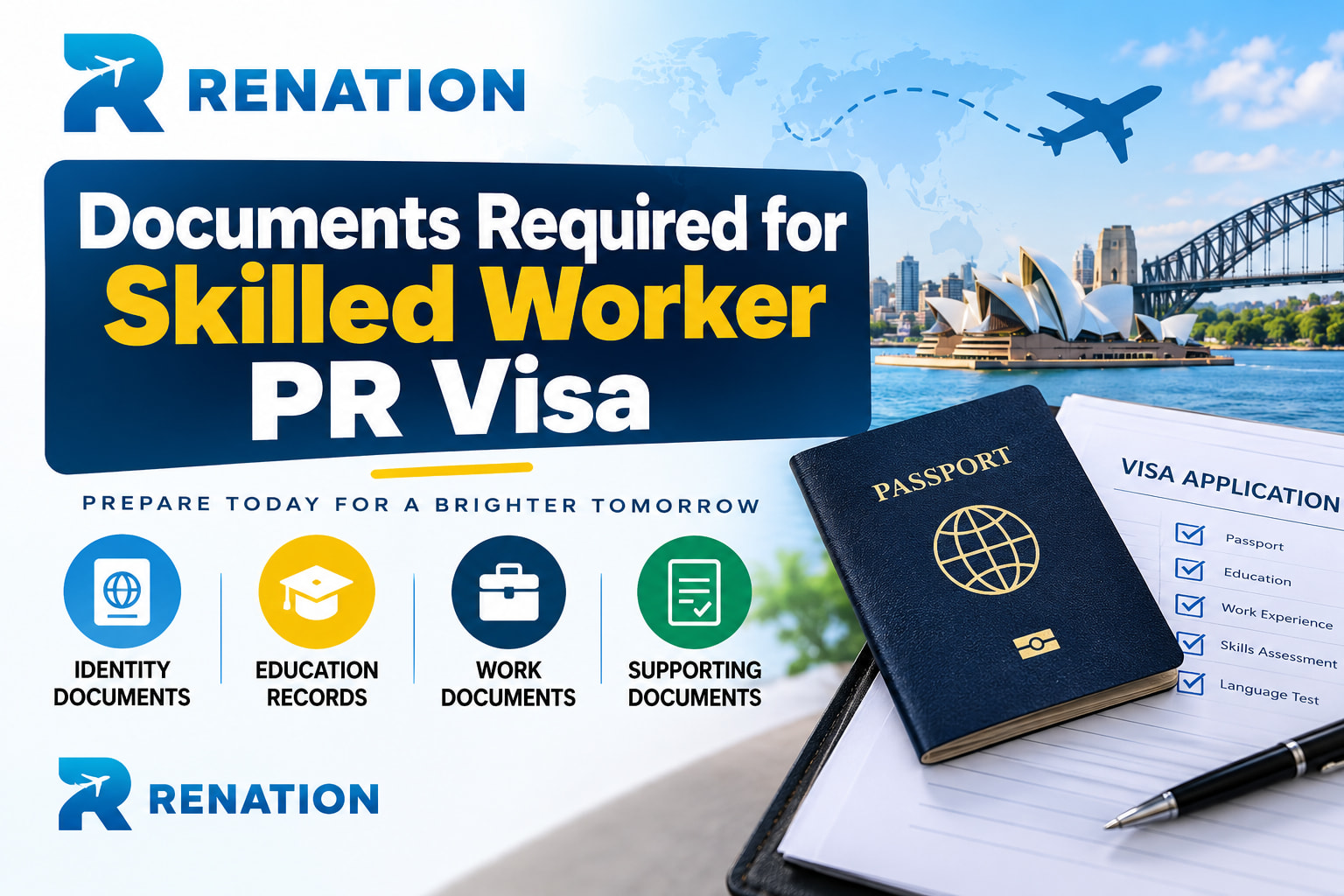
The exact document checklist depends on your destination and visa subclass. Common documents can include:
- Valid passport
- Educational certificates
- Academic transcripts
- Skills assessment
- English-language test result
- Employment reference letters
- Salary slips
- Bank statements where required
- Tax documents
- Updated CV/resume
- Police clearance certificates
- Medical examination documents
- Marriage certificate, if applicable
- Birth certificates for dependants
- Passport-size photographs
- Professional registration or licence, if required
Applicants should always check the official document requirements for their specific visa before submitting an application.
Which Jobs Are in Demand for Skilled Migration?
Skilled migration programs can include occupations from a wide range of industries.
Some commonly relevant professional and skilled sectors include:
IT & Technology
- Software developers
- Cybersecurity professionals
- IT specialists
- Data professionals
- Technology managers
Engineering
- Civil engineers
- Mechanical engineers
- Electrical engineers
- Software engineers
Healthcare
- Nurses
- Doctors
- Allied health professionals
- Healthcare specialists
Construction & Skilled Trades
- Electricians
- Plumbers
- Carpenters
- Construction professionals
Finance & Accounting
- Accountants
- Financial professionals
- Business analysts
Education
- Teachers
- Education professionals
- Training specialists
Hospitality & Tourism
- Hospitality professionals
- Chefs
- Hotel management professionals
Renation Advisors' service information also identifies sectors including Technology and IT, Engineering and Software, Healthcare and Technology, Finance & Accounting, Construction & Skilled Trades, Education & Training, Hospitality and Tourism, Business & Management, and Science & Research.
Important: An occupation being generally in demand does not automatically mean an applicant qualifies for a particular PR visa. Eligibility depends on the specific occupation list, visa subclass and current immigration rules.
PR Visa for Skilled Workers: Australia vs Canada
Skilled migration systems differ by country.
Factor | Australia | Canada | |
Major skilled pathway | Skilled Migration Program | Express Entry and other economic programs | |
Profile system | SkillSelect EOI for several skilled visas | Express Entry profile | |
Points/Ranking | Points-tested skilled visas | Comprehensive Ranking System (CRS) for Express Entry | |
Skilled occupations | Relevant skilled occupation lists | NOC/TEER classification and program criteria | |
Nomination | State/Territory nomination available for certain visas | Provincial nomination can support permanent residence pathways | |
Employer pathways | Employer-sponsored skilled visas | Employer-supported routes and other programs | |
Regional pathways | Regional skilled visas | Provincial/regional immigration programs |
Canada's Express Entry system ranks eligible profiles using the Comprehensive Ranking System (CRS), while Australia's SkillSelect uses an EOI and invitation process for several points-tested skilled visas.
How Can Renovation Advisors Help With Skilled Worker PR?

Choosing the appropriate immigration pathway requires careful assessment of your professional profile, occupation, qualifications and long-term plans.
Renation Advisorsprovides immigration support for people exploring overseas work and permanent residence opportunities. The company offers services including documentation guidance, job-search assistance, test coaching, forex and financial services and post-landing support.
The process can begin with a profile assessment covering your:
- Age
- Education
- Occupation
- Work experience
- Language ability
- Family profile
- Destination preference
- Immigration goals
Renation Advisors also provides an online eligibility assessment and describes its service as supporting clients through study, work, investment and settlement-related immigration journeys.
📞 +91 7303093805 📧 info@renationadvisors.com 📍 FLR-9 Tower D, UCP Sec-39, Gurgaon-122001, Haryana
Frequently Asked Questions About PR Visa for Skilled Workers
1. What is a PR Visa for Skilled Workers?
A skilled-worker PR visa is a permanent residence pathway for eligible professionals and skilled workers. Requirements vary by country, occupation and visa category.
2. Can skilled workers apply for PR without a job offer?
Yes, some skilled migration programs do not require a job offer. For example, Australia's Skilled Independent visa subclass 189 is an independent skilled pathway, while other pathways may involve nomination or employer sponsorship.
However, eligibility and invitation requirements still apply.
3. What are the requirements for skilled worker PR?
Requirements commonly include an eligible occupation, relevant work experience, education, language proficiency, age requirements, skills assessment and health and character requirements.
4. Which country is best for skilled workers to get PR?
There is no single country or program that suits every skilled worker. The appropriate option depends on your occupation, qualifications, age, work experience, language ability, family circumstances and immigration goals.
5. Can I get PR based on my work experience?
Work experience can be an important eligibility or points factor in skilled migration programs. However, experience must meet the requirements of the particular immigration pathway.
6. How many years of work experience are required for skilled migration?
There is no universal requirement. The required amount of experience varies by country, visa subclass and occupation.
7. Is IELTS required for a skilled worker PR visa?
Many skilled migration programs require evidence of language proficiency, but the accepted tests and minimum scores vary by country and visa category.
8. What is a skills assessment for skilled migration?
A skills assessment evaluates whether an applicant's qualifications and professional experience meet the requirements for their nominated occupation under a particular immigration program.
9. What is an Expression of Interest (EOI)?
An EOI is an expression of interest submitted to an immigration system to indicate that you want to be considered for a skilled migration visa. Australia's SkillSelect system uses EOIs for subclasses 189, 190 and 491.
10. What is the minimum points score for Australia skilled migration?
For Australia's points-tested subclasses 189, 190 and 491, the current minimum points threshold is 65 points. Meeting the threshold does not guarantee an invitation.
11. Can I apply for Australian PR as a skilled worker from India?
Indian skilled workers may explore Australian skilled migration pathways if they satisfy the requirements of the relevant visa subclass, including occupation, skills, English, points and invitation or nomination requirements where applicable.
12. Can skilled workers bring their family?
Some skilled migration visas allow eligible family members to be included or subsequently join the primary applicant, subject to the specific visa rules.
13. How long does a skilled PR visa take?
Processing times vary by country, visa subclass, application completeness, processing priorities and individual circumstances. Applicants should check the current official processing-time information for their particular visa.
14. Can I get PR through a regional skilled migration program?
Yes, some countries provide regional pathways. Australia, for example, has regional skilled visas including subclass 491 and subclass 494, with subclass 191 providing a permanent residence pathway for eligible regional visa holders who meet the requirements.
15. Can I apply for PR if I am over 40?
Possibly. Age rules and the impact of age on points vary between immigration programs. Your complete profile should be assessed against the specific visa requirements.
16. What happens after getting permanent residence?
Rights and conditions depend on the destination country. In Australia, permanent residents can generally remain indefinitely under their permanent visa, while travel rights depend on the validity of the visa's travel facility.
Conclusion
A PR Visa for Skilled Workers can provide a structured pathway for professionals who want to build their career and long-term future overseas. However, skilled migration is not simply about having a degree or several years of experience. Your occupation, skills assessment, age, qualifications, language ability, work history and the requirements of the specific immigration program all need to be considered.
For Australia, the Skilled Migration Program, SkillSelect, state or territory nomination, regional pathways and employer-sponsored options can provide different routes depending on an applicant's profile.
For Canada, programs such as the Federal Skilled Worker Program, Federal Skilled Trades Program and Canadian Experience Class operate within the Express Entry framework, subject to their respective requirements.
Leave a Comment
Your email address will not be published. Required fields are marked *