
IELTS vs PTE: Which Test is Better for You

Here is a question that comes up in almost every first consultation we have with a client who is preparing for Canada PR. "Should I go for IELTS or PTE?" And honestly, it is a fair question because the answer is not the same for everyone. Both tests are accepted by IRCC, both measure the same four skills and both can get you to the CLB 7 minimum that most Express Entry programs require. But the experience of giving these two tests is very different and choosing the wrong one can cost you time, money and sometimes an entire immigration cycle.
So instead of giving you a generic comparison table, let us actually talk through what each test involves and what kind of person tends to do better in each format. Because the best test is not the most popular one. It is the one that matches how you think and how you communicate.
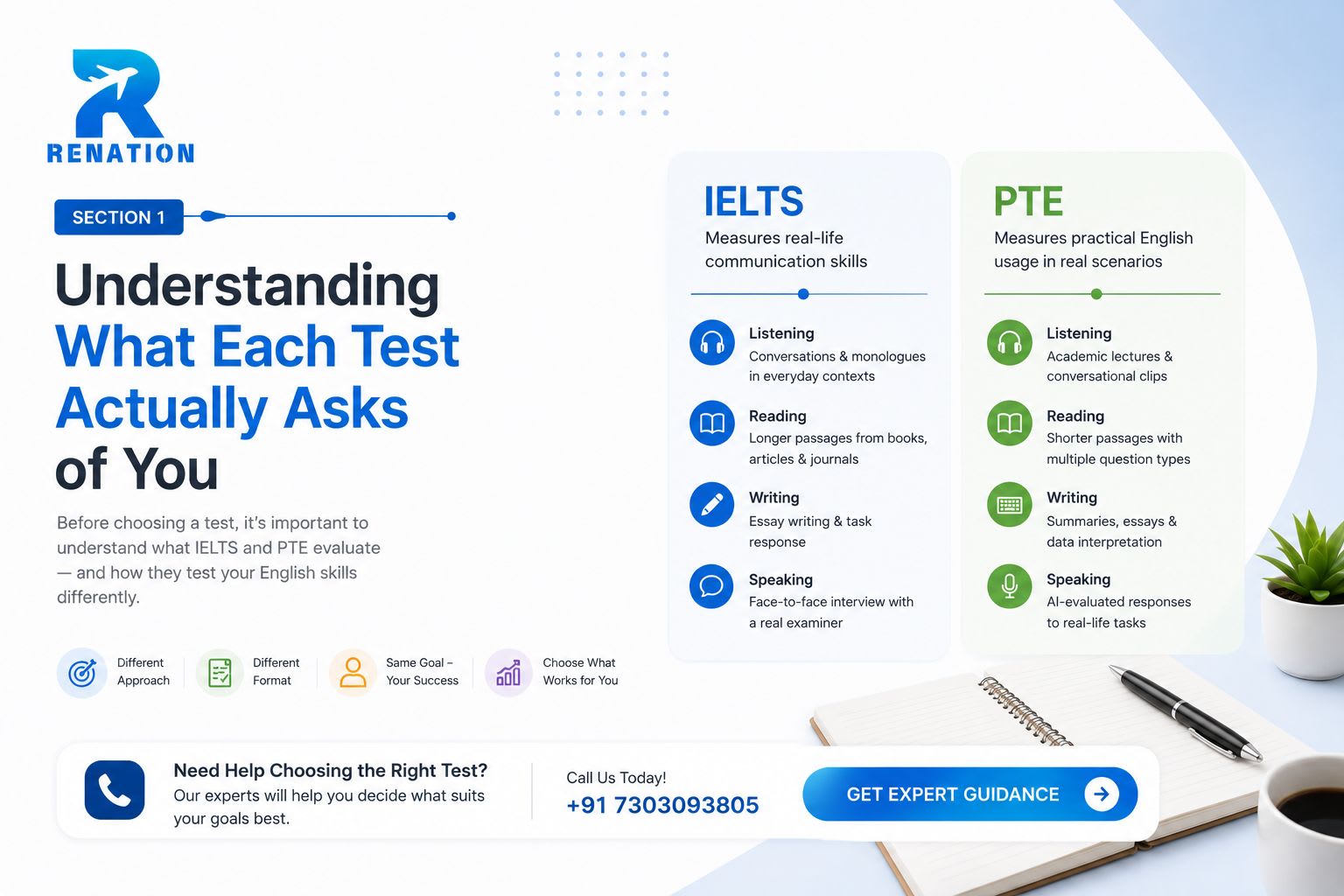
Understanding What Each Test Actually Asks of You
IELTS General Training has been around for over 30 years. It is the most widely recognised English proficiency test in the world and for Canada PR specifically, it has been the default choice for Indian applicants for a very long time. The test covers four sections: Listening, Reading, Writing and Speaking. What makes IELTS distinctive is the Speaking section, which is a live face-to-face conversation with a human examiner. It lasts around 11 to 14 minutes and is broken into three parts: an introduction, a short monologue on a given topic and a broader discussion. For a lot of people, this is actually less stressful than speaking into a microphone with a timer running. The conversational flow feels more natural and there is room to recover if you stumble.
The IELTS result comes in around 3 to 5 days for the computer-delivered version and up to 13 days for the paper-based version. The test fee in India is approximately Rs 18,000. One feature that was introduced a couple of years ago and genuinely matters is the One Skill Retake option. If you score well in three sections but fall short in one, you can retake just that section without having to sit the entire test again. This is a significant advantage over PTE where you have to rebook and pay for the complete exam every time.
PTE Core is newer to the Canada immigration space. It was officially accepted by IRCC in 2024 and has been gaining popularity quickly because of one major reason: the results come back in 24 to 48 hours. That is it. For applicants who are on a tight timeline and cannot afford to wait a week or more for scores, this is a genuine advantage. The entire test is computer-based and AI-scored. There is no human examiner involved at any stage. You speak into a microphone, the system captures your response and an algorithm evaluates it.
PTE Core tests the same four skills but the question formats are different and often more integrated. For example, a single task might ask you to listen to a recording and then write a summary, combining two skills at once. The Speaking section involves retelling a lecture, describing an image and answering short questions. For people who are comfortable with computers and tend to get nervous in face-to-face situations, this format removes a significant source of anxiety.
The test fee for PTE in India is approximately Rs 15,900, which is slightly lower than IELTS. Both tests are available at test centres across India and neither offers an at-home testing option, so you will need to go to a centre regardless of which one you choose.
How Each Test Converts to the CLB Score That IRCC Uses
This is the part that most people do not spend enough time on and it matters a lot for your Canada PR language test outcome.
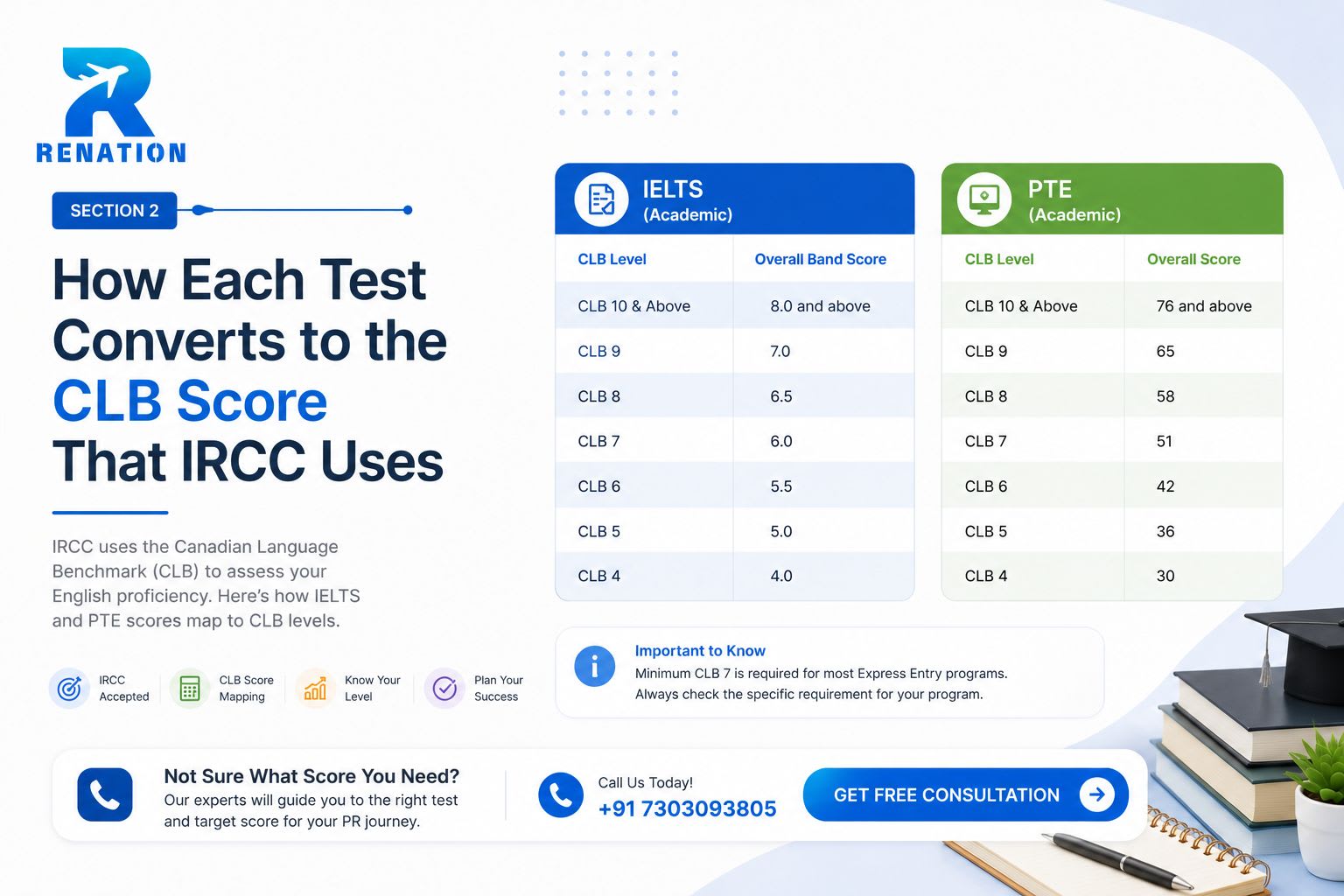
IRCC does not use your IELTS band score or PTE score directly. It converts both into CLB, which stands for Canadian Language Benchmarks. The minimum CLB 7 is required for most Express Entry programs including the Federal Skilled Worker Program. CLB 9 gives you 136 CRS points per language ability if you are a single applicant. The higher your CLB, the higher your CRS score and the better your chances of receiving an Invitation to Apply in an Express Entry draw. This means the language test is not just a formality. It is a direct input into your ranking in the pool.
Here is how the conversion works in practical terms for the two tests:
For IELTS General Training, a band score of 6.0 in each module converts to CLB 7. A score of 7.0 in each module converts to CLB 9. Getting from CLB 7 to CLB 9 in IELTS terms means moving from 6 bands to 7 bands across all four sections.
For PTE Core immigration purposes, a score of 60 in each communicative skill converts to approximately CLB 7. A score of 72 converts to approximately CLB 9. The PTE scoring scale runs from 10 to 90 so these numbers sit in the upper-middle range and are achievable with focused preparation.
The practical difference is that some people find it easier to jump from 60 to 72 on PTE because the AI scoring is consistent and does not vary based on who is evaluating your response. Others find the human-evaluated IELTS Writing and Speaking sections easier to do well in because they can express themselves more naturally in a free-flowing format. This is genuinely personal and there is no universal rule.
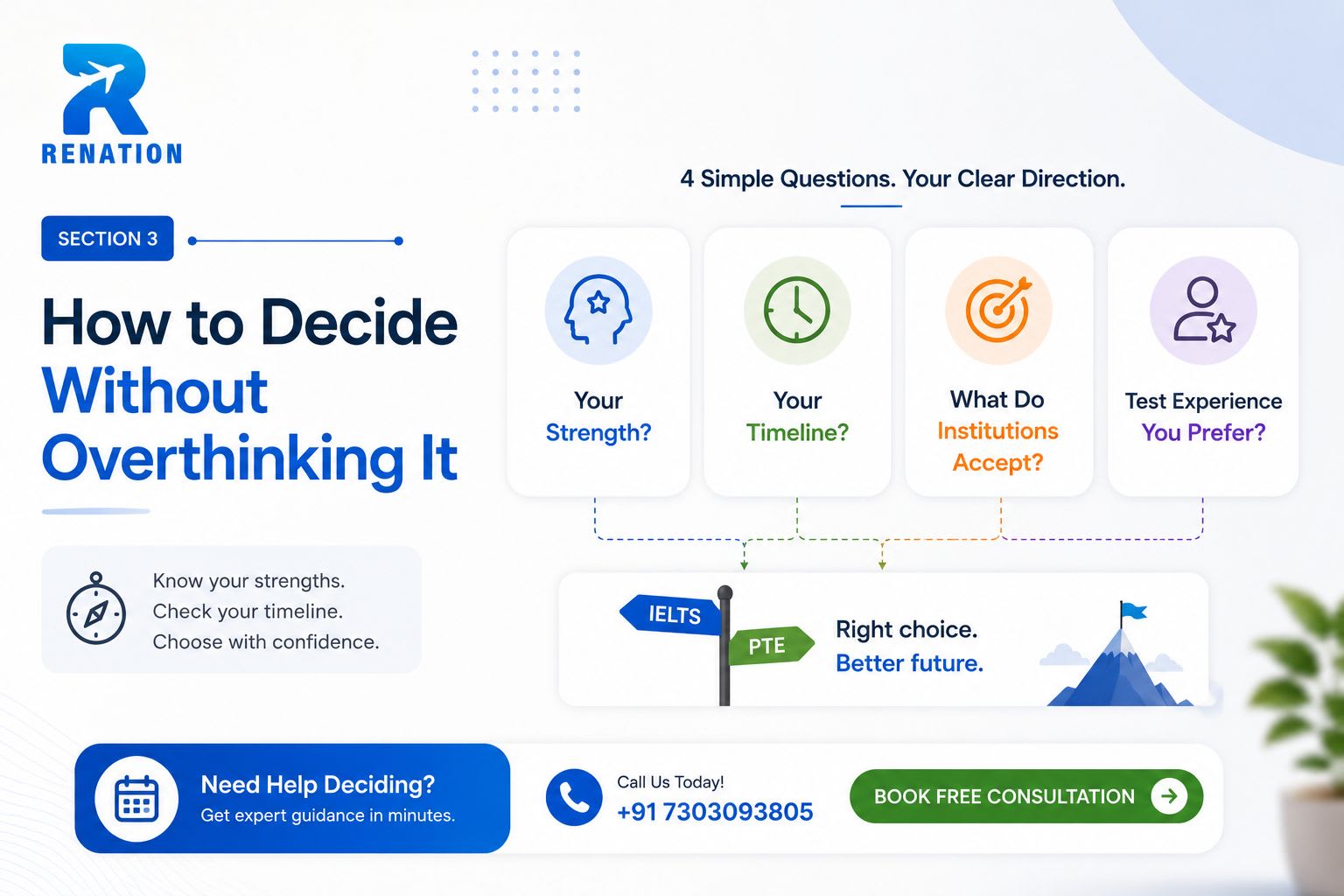
This is the part where most guidance gets vague and tells you to "consider your strengths". That is not wrong but it is not helpful enough on its own. Here is a more specific way to think about it.
If you are someone who speaks more fluently in a conversation than when answering structured prompts, IELTS Speaking will feel more comfortable. The examiner can follow up, you can clarify and the interaction has a human quality that the computer cannot replicate.
If you are someone who gets nervous being evaluated face-to-face and does better when you know the criteria are fixed and consistent, PTE removes that variable entirely. The AI does not have a bad day and it does not judge your accent as long as your words are clearly articulated and grammatically correct.
If your timeline for submitting your Express Entry profile is tight, PTE Core's 24 to 48 hour result turnaround is a real practical advantage. IELTS on computer delivers results in 3 to 5 days which is still fast but if you are working against a draw deadline or a document submission window, every day counts.
If you have already attempted one test and did not get the score you needed, it is worth considering the other format. Sometimes people who struggle with IELTS Speaking do significantly better in PTE's structured prompts and vice versa. The two tests are different enough that switching is a legitimate strategy and not a fallback.
If you are planning to use your English test result for purposes beyond Canada PR, such as applying for a job at a multinational company, a university in the UK or a professional body in Australia, IELTS has broader global recognition. Most institutions outside Canada do not yet accept PTE Core the way they accept IELTS so if your plans extend beyond immigration, IELTS is the safer bet.
The CLB score you are aiming for should also factor into this decision. If you are targeting CLB 9 to maximise your CRS points, think honestly about which test format gives you the best chance of hitting that target consistently. Attempting both as mock tests before you book the real one is something we always recommend. Both Pearson and the IELTS official platforms offer practice materials and attempting one full mock of each test under timed conditions will tell you more about your fit than any comparison article can.
Leave a Comment
Your email address will not be published. Required fields are marked *