
How to Build an International Resume That Gets You Hired
Most people working in India have a resume. It has a photo at the top, a career objective that reads like every other career objective ever written, a list of responsibilities from each job and probably a line somewhere that says "references available on request." That resume is fine for India. The moment you send it to a Canadian employer or a UK recruiter, it is working against you.
This is one of the most underestimated parts of moving abroad. People spend months sorting out their IELTS score and their ECA documents and then send a completely unoptimised resume to international employers and wonder why no one responds. The truth is that an international resume is a different document from what most Indian professionals are used to writing. It follows different rules, speaks in a different tone and is evaluated very differently from the moment it is submitted.
This blog is going to walk you through what that difference actually looks like and how to fix it before your next application goes out.
What an International Employer Actually Expects to See
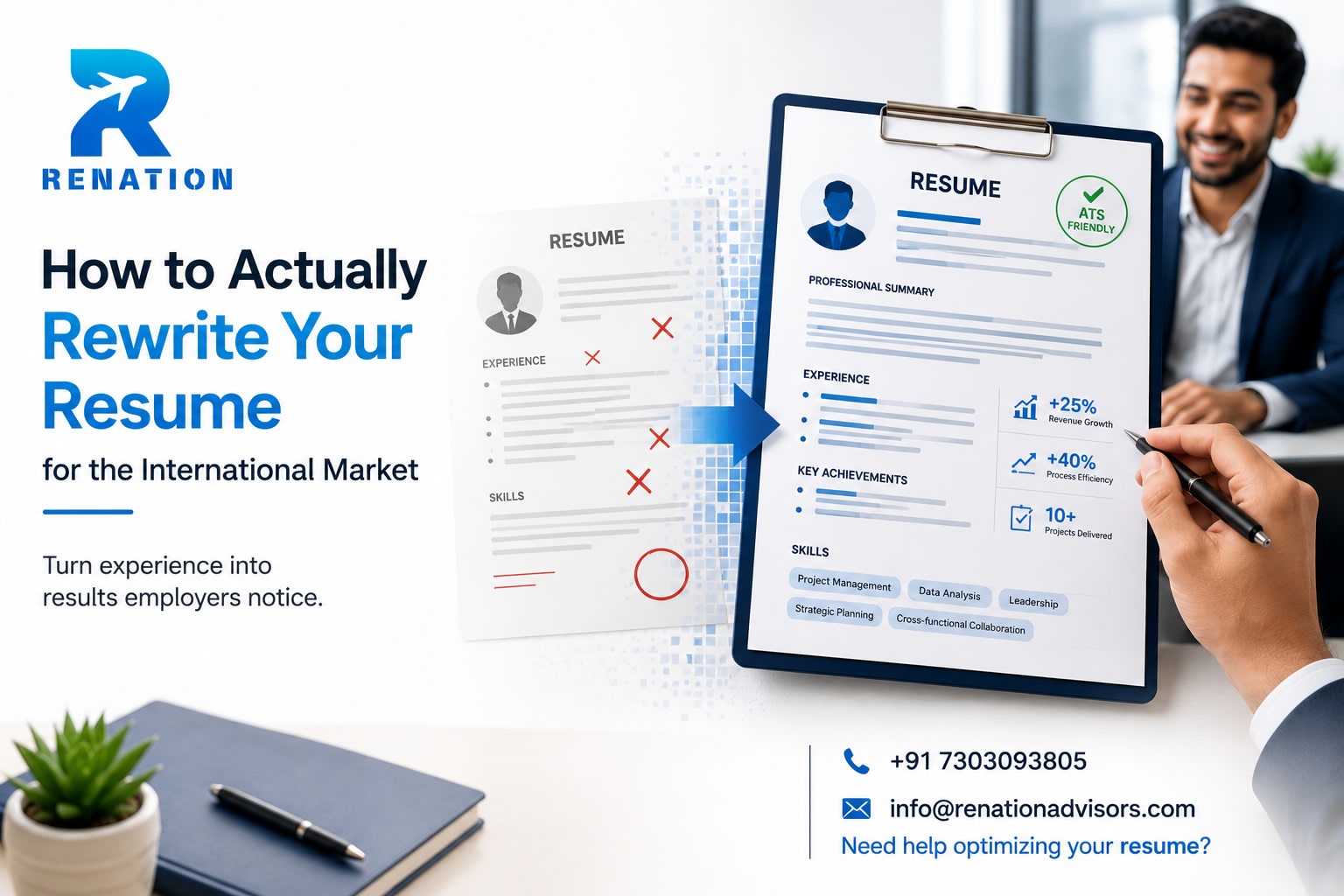
The first thing you need to understand is that most large employers abroad do not read your resume first. A piece of software does. The ATS friendly resume format exists because almost every mid-to-large company in Canada, Australia and the UK uses an Applicant Tracking System to filter applications before a human ever sees them. This system scans your document for specific keywords that match the job description. If your resume does not contain those keywords or if the formatting confuses the system, your application gets filtered out automatically regardless of how qualified you are.
This is why resumes with photos, tables, columns, decorative fonts and graphics tend to fail internationally. ATS systems read documents linearly. A two-column layout that looks clean to the human eye gets read in a scrambled order by the software. A text box with your contact information never gets parsed at all. The system does not see it. You effectively become invisible.
For a Canadian resume format specifically, the expectations are very clear. The document should be one to two pages long depending on your experience level. If you have fewer than ten years of experience, one page is expected. If you are a senior professional, two pages is acceptable but nothing more. The header should contain your name, a city and province if you are already in Canada or your current location if you are applying from India, a phone number and a professional email address. That is it. No photo. No date of birth. No marital status. No nationality listed. Canadian hiring laws specifically protect candidates from discrimination based on personal characteristics, and including that information on your resume actually signals that you are unfamiliar with the local hiring culture.
The work experience section should be written in reverse chronological order starting from your most recent role and working backwards. Each role should list the company name, your job title, the dates of employment and then three to five bullet points that describe what you actually achieved in that role. Not what your job description said. What you actually did and what it resulted in. The difference between "Responsible for managing the sales team" and "Led a team of 8 sales professionals and grew regional revenue by 34% in 12 months" is the difference between a resume that gets ignored and one that gets a call.

The Specific Mistakes Indian Professionals Make When Applying Abroad
There are patterns that come up again and again when we look at resumes from Indian candidates who are applying to international employers for the first time. These are not unusual errors. They are completely logical outcomes of writing a resume the way Indian companies expect them to be written. The problem is that the rules are genuinely different abroad and those habits need to be unlearned.
Here is what tends to go wrong in most resume for abroad jobs applications from India:
Writing a career objective instead of a professional summary. Career objectives talk about what you want. International employers want to know what you offer. A professional summary is 2 to 3 sentences at the top of the resume that tells the reader exactly who you are professionally, how many years of relevant experience you have and what your strongest contribution looks like. It is your first impression and it needs to be specific to the role you are applying for.
Using passive language to describe experience. Phrases like "was responsible for" or "assisted in the management of" make your contribution sound uncertain. International resumes use action verbs at the start of every bullet point. Led, managed, delivered, increased, reduced, built, designed, implemented. These words communicate ownership and confidence and that is what global employers are looking for.
Including a photo. This is one of the most common mistakes and it immediately signals unfamiliarity with international hiring norms. In Canada and most English-speaking countries, photos on resumes are not just unnecessary. They can actually create legal complications for the employer and some recruiters will not move forward with an application that includes one.
Making the resume too long. In India, a detailed four or five page resume can signal seniority and thoroughness. Internationally, especially in Canada and the US, length is treated as an inability to prioritise. A one-page resume for someone with six years of experience is not sparse. It is disciplined and that quality is valued.
Not tailoring the resume for each role. Sending the same resume to every employer is one of the biggest reasons qualified candidates get ignored. Every job posting contains specific keywords related to the skills and tools required for that role. Incorporating those exact phrases into your resume is not gaming the system. It is speaking the language that both the ATS and the hiring manager are looking for.
Listing duties instead of achievements. This is the single biggest quality gap in resumes from Indian applicants. International employers do not want to know what your job was. They want to know what you did with it. Every bullet point should ideally contain a result. If you cannot quantify it in numbers, quantify it in scope or impact. "Managed onboarding process for 40+ new hires per quarter" tells a story. "Responsible for onboarding" tells nothing.

How to Actually Rewrite Your Resume for the International Market
Once you understand what is wrong, the rewrite becomes very focused. You are not starting from scratch. You are translating your existing experience into a language that international employers understand.
Start with your contact section. Remove the photo, date of birth, marital status and address. Replace it with your name, the city you are in or plan to be in and a professional email. Add your LinkedIn profile URL if your profile is updated and complete.
Then write your professional summary from scratch. Forget the old career objective. Write two to three sentences that describe your professional identity, your strongest skill and what kind of value you bring. Do it specifically for the role you are applying for. It should read like the first few lines of a strong cover letter, not like a generic description that could apply to anyone in your field.
Go through your work experience and rewrite every bullet point to start with an action verb and end with an outcome wherever possible. Use numbers. Percentages, team sizes, budget figures, timeframes. Anything concrete that tells the employer the scale of your work. If your previous employer's name is not well known internationally, add a one-line descriptor in brackets to give context. For example, "Tata Consultancy Services (Fortune 500 IT services company, 600,000+ employees)" means something to a Canadian recruiter who has never heard the name before.
For an overseas job application targeting Canada specifically, also check that your resume uses Canadian spelling conventions and terminology where relevant. Project management in Canada and India uses largely the same vocabulary but industry-specific terms sometimes differ and local terminology matters when an ATS is doing the first read.
Finally, save the document as a PDF unless the employer specifically asks for a Word file. PDFs preserve your formatting. Word files can shift and break depending on what software the recruiter is using to open them.

Leave a Comment
Your email address will not be published. Required fields are marked *