
Canada PR Visa 2026: Eligibility, Process, Fees & Requirements
Canada PR Visa 2026: Eligibility, Requirements, Process, Fees & Benefits
Canada is still one of the top choices for people chasing better career opportunities, solid education, and a place to put down roots long-term. A Canada PR visa lets eligible foreign nationals live, work, and study there as permanent residents — no expiry date hanging over their heads.
That said, whether you actually qualify comes down to your specific profile: age, education, work experience, language ability, occupation, and a handful of other eligibility factors. If you're mapping out your Canadian immigration journey for 2026, the first real step is figuring out which pathway even applies to you.
What Does Canada PR Actually Mean?
Permanent residence gives you the right to live in Canada indefinitely. As a PR holder, you can:
- Live and work almost anywhere in the country
- Study at Canadian institutions
- Tap into many publicly funded benefits
- Sponsor eligible family members
- Eventually apply for citizenship
- Get legal protection under Canadian law
It's worth being clear that PR isn't citizenship. You still have residency obligations to keep up with, and citizenship comes with its own separate set of requirements.
How People Get PR in 2026
There's no single door into Canadian permanent residence — which route works for you depends heavily on your background.
Express Entry. This is the system Canada uses to manage its main economic immigration programs: the Federal Skilled Worker Program, Canadian Experience Class, and Federal Skilled Trades Program. You build a profile, and it gets scored under the Comprehensive Ranking System (CRS) based on things like age, education, language, and work history. Score well enough, and you might get an Invitation to Apply in one of the periodic draws.
Provincial Nominee Programs (PNP). Provinces and territories run their own programs to attract people who fit their local labour market needs. If a province nominates you and that nomination links to Express Entry, it can give your CRS score a serious boost. Each province sets its own rules, streams, and target occupations, so it's worth checking what your target province is actually looking for.
Work visa to PR. A work permit on its own doesn't hand you PR — but Canadian work experience can strengthen an application under the Canadian Experience Class or certain provincial streams. What actually helps depends on your occupation, how long you've worked, and your language scores.
Study visa to PR. International students sometimes use their time in Canada as a stepping stone. A study permit lets you attend a designated learning institution, and finishing an eligible program can open the door to a post-graduation work permit — which in turn might support a later PR application. Just don't assume any course automatically leads somewhere; it doesn't work that way.
What Makes You Eligible
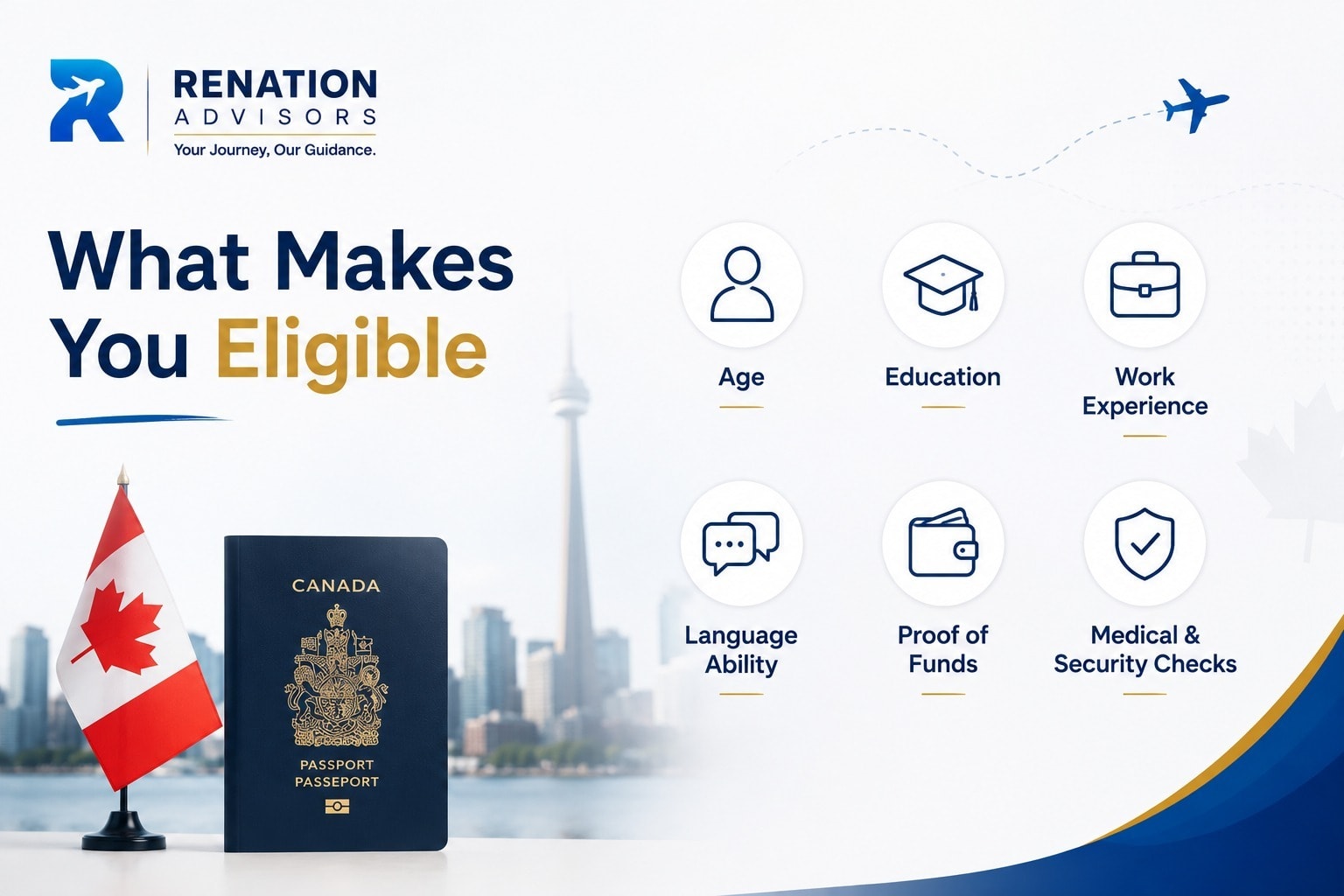
The exact criteria shift depending on the program, but a few factors show up across nearly all of them:
Age matters most under the CRS scoring system, where certain age brackets score higher.
Education — the more you have, generally the better your ranking. If your degree is from outside Canada, you'll likely need an Educational Credential Assessment (ECA) for programs that require one.
Work experience, particularly in a skilled occupation, carries real weight in most applications.
Language ability in English or French is arguably the single biggest lever for many programs. You'll need to sit an approved test and hit the required score for whichever program you're applying under.
Proof of funds is required for some applicants, depending on category and circumstances.
Medical, security, and admissibility checks apply across the board.
Documents You'll Likely Need
This varies by program and personal situation, but expect to gather:
- Valid passport
- Educational certificates
- ECA report (if required)
- Language test results
- Employment reference letters and work experience proof
- Proof of funds, where applicable
- Police certificates
- Medical exam documents
- Civil status documents (marriage, birth certificates, etc.)
- Provincial nomination paperwork, if relevant
Get the details right here. Missing or inconsistent documents are one of the most common reasons applications get delayed or run into trouble.
What the Process Looks Like (Express Entry)
- Check whether you're eligible in the first place
- Take the required language test
- Get an ECA done, if needed
- Work out your likely CRS score
- Build your Express Entry profile
- Sit in the candidate pool
- Wait for an Invitation to Apply, if you're selected
- Submit the full PR application
- Complete biometrics, medical exams, and other checks
- Wait on a decision
The steps shift somewhat depending on which pathway you're using, but this is the general shape of it.
Why Bother With PR?
- You can live and work almost anywhere in the country, without needing a specific employer or job offer to stay.
- Education access opens up, sometimes with domestic tuition rates depending on the school and program.
- Healthcare — PR holders are generally eligible for publicly funded healthcare, though the specifics depend on your province.
- Family sponsorship becomes possible for certain relatives under Canada's family-class rules.
- Citizenship eventually becomes an option, once you've met the requirements.
What Does It Cost?
Total cost depends entirely on which program you go through and your personal situation, but budget for:
- Language testing
- ECA fees
- Government application fees
- Biometrics
- Medical exam
- Police certificates
- Translation and related document costs
- Settlement funds, where required
Fees change more often than people expect, so double-check current amounts through official Canadian government sources before you apply — don't rely on older figures floating around online.
PR vs. Work Visa vs. Study Visa
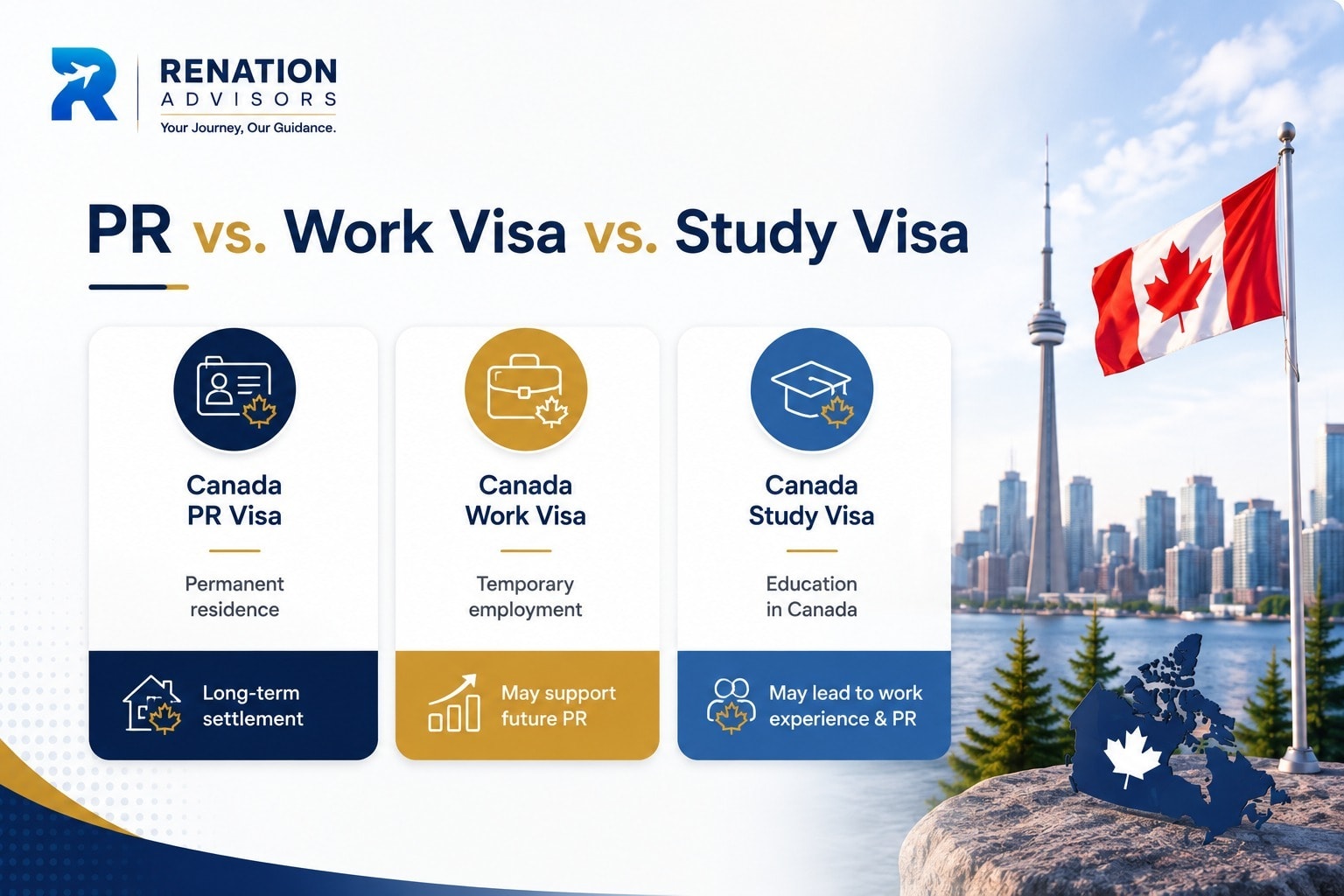
Option | Main Purpose | Where It Can Lead |
Canada PR Visa | Permanent residence | Direct long-term settlement |
Temporary employment | May support future PR eligibility | |
Canada Study Visa | Education in Canada | May lead to work experience and, eventually, PR |
Which one makes sense for you depends on your education, occupation, experience, finances, language score, and what you're actually trying to achieve long-term.
Common Questions
Is Canada PR easy to get?
Not automatically, no. It comes down to which program you apply through and how your specific profile stacks up.
Can I get PR without a job offer?
Yes — several Express Entry programs don't require one at all.
What CRS score do I need?
There's no fixed number. Cut-off scores move around from one draw to the next.
Can I apply from India?
Yes, applicants can apply from outside Canada, India included, through the relevant programs.
Does a study visa guarantee PR?
No. But the right education followed by qualifying work experience can support a later PR application.
Does a work visa lead to PR?
Not automatically — but the right kind of Canadian work experience can help you qualify for programs like the Canadian Experience Class.
How long does it take?
It varies a lot — by program, by how busy the system is, by how complete your application is. Check current processing times before you apply rather than going off old estimates.
Can my family come with me?
Often, yes — depending on the program, eligible family members can be included or sponsored.
Why Work With Renation Advisors
Sorting through Canada's immigration options can get confusing fast — every program has its own eligibility rules, paperwork, and process. Renation Advisors is an immigration consultancy in India that helps people work through their Canadian options, from an honest profile assessment through to filing the actual application.
Whether you're eyeing a PR visa, a study visa, or a work visa, having someone walk you through which pathway actually fits your situation makes the process a lot less overwhelming.
Conclusion
A Canada PR visa can be a genuinely significant step toward building a life there. Between Express Entry, PNP, and study or work-based routes, there's more than one way in — it just depends on your qualifications and circumstances.
Before you apply, take an honest look at your eligibility, language score, education, work history, paperwork, and finances. And since Canadian immigration rules shift over time, always confirm the latest requirements with official sources before submitting anything.
Looking to start the process? Renation Advisors can help you figure out the right pathway and support you end-to-end.
Leave a Comment
Your email address will not be published. Required fields are marked *